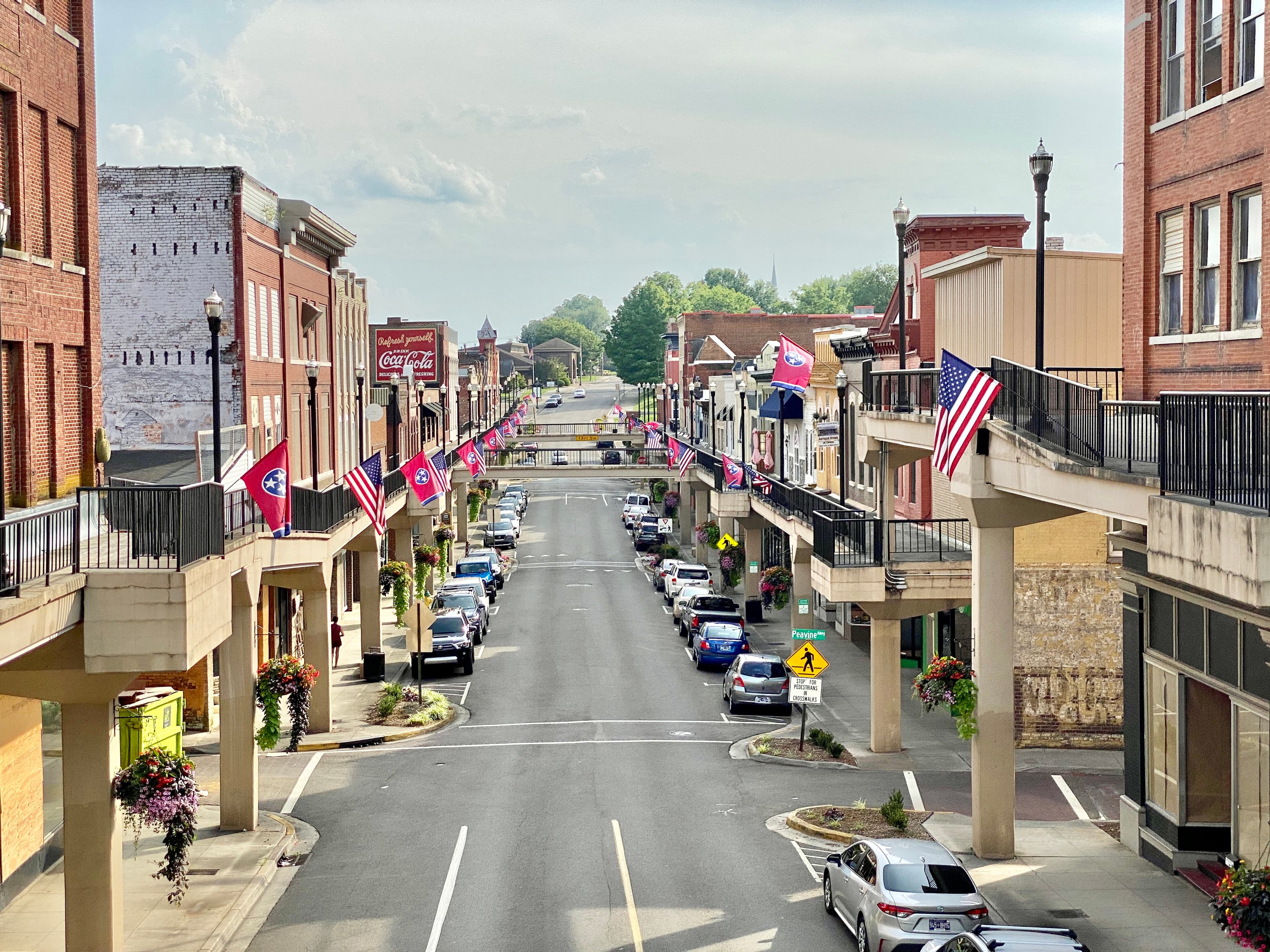
The SkyMart.
The structure didn't change. The category did.
the corridor before
Before
Pre‑1967 downtown Morristown was a small railroad commercial center of two‑ and three‑story masonry buildings strung along Main, Henry, and Cumberland Streets. The district’s period of significance, as later inventoried by the National Park Service, runs from 1875 to 1967 — meaning the SkyMart itself is the closing bookend of the historic district it was built into. The commercial core emerged in the late nineteenth century at the intersection of two rail lines, most notably the Knoxville and Bristol “Peavine Railroad” branch of Southern Railway, which ran north out of downtown from 1891 until 1928.
By the early 1960s, downtown was an active but stressed wholesale and retail hub serving roughly 20,000 city residents and a wider Hamblen County trade area. The city’s population was 21,267 in 1960 and would shrink slightly to 20,318 by 1970— a 4.4 percent loss over the decade in which the SkyMart was designed, financed, and built. Hamblen County’s economy had pivoted from nineteenth— century agriculture and paper milling to industrial fiber production after the American Enka Company opened its rayon plant in 1947, concentrating new jobs at the city’s edges rather than in the historic core.
The competitive threat most often cited in contemporary accounts is “a suburban shopping mall on the city’s west side” draining traffic from Main Street. The claim requires care: the conventional indoor mall that anchors west Morristown today — College Square Mall — did not break ground until January 1987 and did not open until 1988. The “west— side mall” that motivated downtown leaders in 1962–1966 was therefore a strip‑format predecessor or a generic suburban‑retail threat, not College Square. The pattern was nonetheless real: postwar Tennessee retail was migrating to car‑oriented sites with free parking, and downtown was losing share.
Then came the water. Turkey Creek ran in multiple piped channels under downtown streets, and a sudden deluge would push the system past capacity. The Morristown Main Street Program’s own account describes the early‑1960s flood sequence as the event that “nearly wiped out” the downtown commercial district. Civic memory has compressed the sequence into “the 1962 flood,” but the strongest photographic record on file is dated July 8, 1963. Both events appear in the National Weather Service archives. What is certain is that by 1963 the political ground had moved: damage from successive Turkey Creek floods was the trigger that turned a slow retail decline into a formal urban‑renewal mandate.
That mandate became the Morristown Urban Renewal Plan of 1963, adopted under the federal urban‑renewal program created by the Housing Act of 1949 and expanded through the 1950s. The mayor under whom the plan was adopted was C. Frank Davis, who held the office from roughly 1958 to 1965. The plan packaged two problems — downtown commercial decline and Turkey Creek flooding — into a single federal application. The pedestrian walkway that became the SkyMart was, in financial terms, bolted onto a flood‑control project. That coupling is what made the federal money flow, and it is what would later allow the structure to outlive its commercial thesis: the underlying public investment was always justified by the creek, not the retail.
decision, timeline, cost
Build
The architect of record was Hubert Bebb, working through Bebb & Fleming, Architects and Engineers — a Knoxville‑area firm formed in 1960. Bebb (Cornell B.Arch. 1928) had relocated to Gatlinburg in 1950 from a Chicago practice, drawn the Clingmans Dome observation tower in 1959, and would later design the 1982 Knoxville Sunsphere through his successor firm Community Tectonics. The Tennessee Encyclopedia treats Bebb as one of the defining East Tennessee architects of the postwar period.
Bebb’s named inspiration for the SkyMart was the Chester Rowsin Chester, England — a medieval two‑tier covered shopping arcade dating to the thirteenth century, with continuous first‑floor galleries running above street‑level shops along the city’s four principal streets. Bebb had visited Chester and named the Rows as his model: a two‑story commercial street, sheltered above, with second‑floor galleries running over street‑level shops. The design year per the #SOSBrutalism case file is 1964; construction ran 1964 through completion in spring 1967.
A medieval two‑tier covered shopping arcade, the second floor reimagined as a new retail street.
— Bebb's model: the Chester Rows
The financing structure of the SkyMart is the most reliably documented number in the case, and it is the single number that most clearly distinguishes Morristown from every other American skyway system built in the same decade. Per the Crossroads Downtown Partnership, the Wikipedia historic district article, the East Tennessee Visitors Guide, and the 2024 Bloomberg CityLab feature, the split was:
- Approximately $2 million from private building owners, spent upgrading individual buildings and constructing ramps and connections from the elevated walkway into their second floors;
- Over $5 million in government funding, spent on the elevated walkway structure itself and on enlarging and rerouting the underground channel carrying Turkey Creek — the flood‑control project bundled into the urban— renewal package.
Total public‑private investment is therefore roughly $7 million in mid‑1960s dollars, of which roughly 71 percent was public and 29 percent private. This is the inverse of the financing pattern of most American skyway systems built in the same period — the Minneapolis system, for comparison, was overwhelmingly private. The Morristown bet is, in financial terms, a federal urban‑renewal flood‑control project that delivered a pedestrian walkway as part of the same scope of work.
The political authorship traces back to the Morristown Urban Renewal Plan of 1963 and to Mayor C. Frank Davis, under whom the plan was adopted. The team has not located substantive contemporary documentation of organized opposition in the open‑web record. The absence may reflect actual broad support across building owners — whose properties received roughly $2 million in public‑leveraged investment — or it may simply reflect that contrarian voices did not survive into later civic memory. Honest finding: small‑town newspaper coverage of an opposition campaign would likely have to be retrieved from Citizen Tribune microfilm or Knoxville News‑Sentinel archives that are not yet digitized.
The structure opened with a multi‑day grand celebration built around May 4, 1967. Press accounts describe a parade and concerts on Main Street featuring Tex Ritter, Porter Wagoner, and a 21‑year‑old Dolly Parton— then a new addition to Wagoner’s show — with regional Tennessee politicians in attendance. The completed structure was a four‑block lattice of cast‑concrete elevated sidewalks on both sides of Main Street, connected by five concrete bridges spanning the street, with ramps and stairs providing access from grade. Original materials were exposed cast concrete, painted in the early 2010s, with cast‑concrete planters along the deck that have since been removed. The result was, and remains, the only second‑story elevated sidewalk system of its kind still standing in the United States.
the arc through 2026
Compound
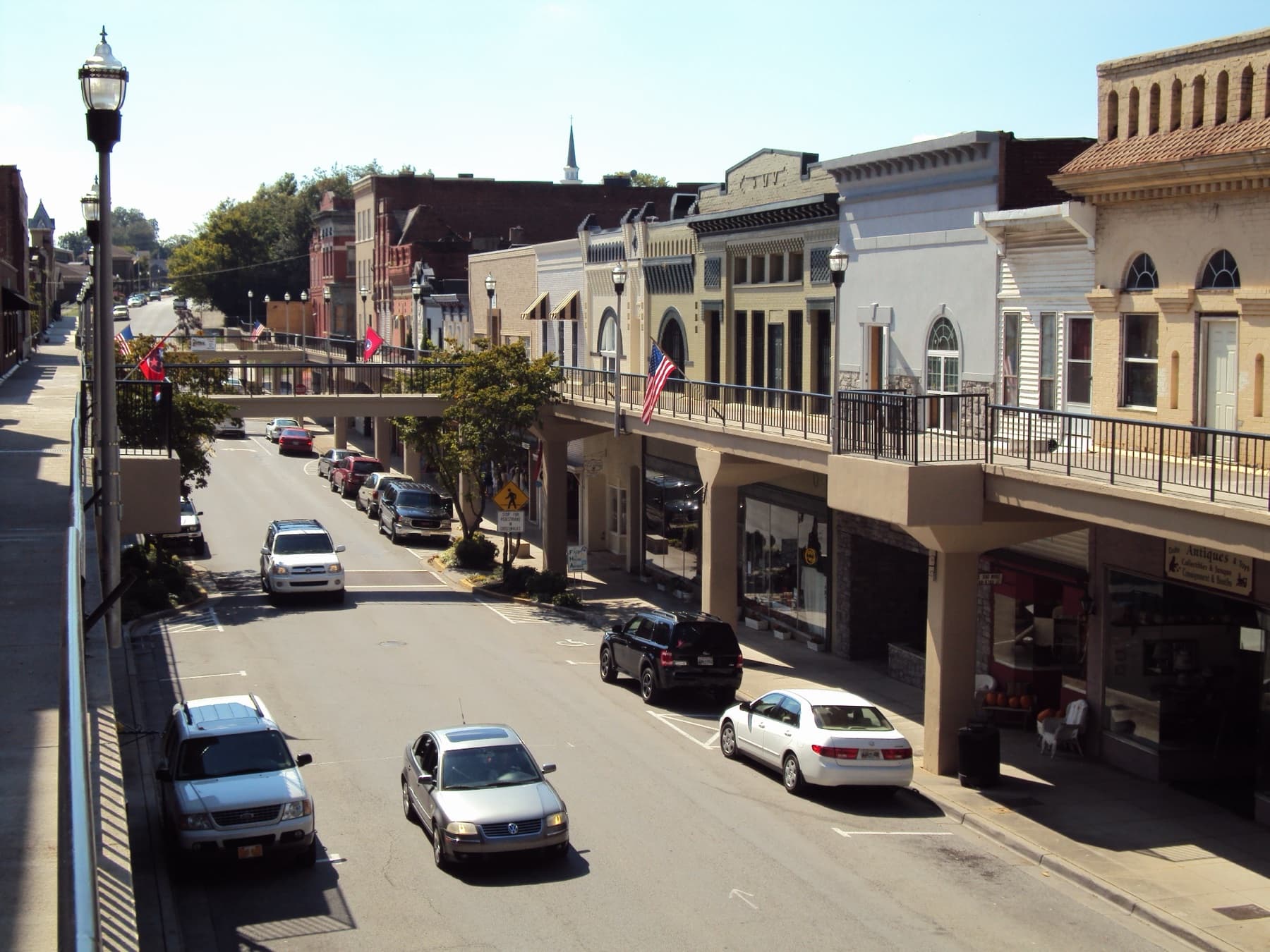
The retail thesis failed quickly. By the consensus of every retrospective account, the SkyMart did not generate the second‑floor shopping economy its boosters projected, and the suburban competition kept growing. Strip‑format retail expanded west through the 1970s and 1980s; the full enclosed mall — College Square — opened on the city’s west side in 1988 with 459,705 square feet of leasable area and five anchors. That mall pulled what remained of downtown’s anchor retail. The SkyMart, designed for a second‑floor shopping economy that never materialized at the scale projected, had — by one 2009 account in The Architect’s Newspaper(“The High Line of Hamblen County”) — come to serve as little more than a roof over the sidewalk and a remnant of 1960s urban‑renewal idealism. (The account is widely cited; the full article text sits behind a paywall and could not be independently retrieved.) Every retrospective tells the same story: many of the second‑floor spaces, even after building owners cut doors through to reach the walkway, remained largely empty.
What is striking, however, is that the SkyMart was never demolished. Across the 1980s and 1990s — the decades in which most American downtown skyway systems were either rotting in place or being torn out — Morristown kept maintaining its structure, with the western end shortened due to demolition of adjacent buildings but the four‑block core preserved. By the mid‑2010s, the city was actively reinvesting in a recognizable rhythm:
- In 2015, a Tennessee Department of Transportation award of roughly $1 million funded a greenway expansion connecting downtown to Fulton‑Hill Park via approximately 0.45 miles of new trail — the first move framing the SkyMart as a node in a regional park network rather than a shopping concourse.
- In 2016, the Crossroads Downtown Partnership secured TNECD Main Street support that opened SkyMart Venture Placeon Main Street in 2017 — a Co.Starters business‑training storefront that served 40 participants in its first year and supported 20 business starts or expansions, filling visible vacancy with a civic tenant rather than a retail one.
- In late 2017, Morristown Utility Systems completed a seven‑month lighting and ceiling overhaulof the SkyMart designed by Gresham Smith, replacing 86 high‑pressure sodium fixtures with decorative LEDs, installing 74 new loudspeakers, and enclosing the cable‑tray ceiling that had become a pigeon‑nesting health hazard — the first comprehensive infrastructure upgrade since opening.
- In 2022, Morristown earned National Main Street Accreditationfrom the National Main Street Center of the National Trust for Historic Preservation — the institutional credential that recodified the corridor as preserved historic infrastructure rather than failed mid‑century retail.
- In March 2023, Tennessee’s Historic Development Grant Program directed $1,729,340 to five Morristown building owners for second‑floor work on the J.W. Arnold Building, Felknor Building, J.G. McCroy 5 & 10 Cent Store, Sheeley Piano Building (now 109 Lofts), and 177 W. Main. The work targeted apartments, lofts, and event venues — the spaces the SkyMart was originally built to deliver foot traffic to, now retooled as residential.
The “SkyMart District” framing now used by the Morristown Area Chamber of Commerce, the Crossroads Downtown Partnership, and the City is recent and consistent with the reinvestment arc above: warmer‑month programming, civic events, and a steady redirection of public capital toward second‑floor space that the elevated walkway makes accessible.
National coverage caught up in January 2024. Bloomberg CityLab’s David Zipper published “Morristown: Why a Tennessee Town Built a Skywalk to Rescue Downtown,” arguing that the SkyMart did not save downtown the way its 1967 boosters projected, but remains a uniquely intact piece of mid‑century urban‑renewal infrastructure and the only second‑story elevated sidewalk system of its kind remaining in the United States. Strong Towns responded weeks later with an Upzoned podcast framing Morristown as a cautionary tale: the original investment “didn’t pan out as a long— term strategy for economic prosperity.” Both readings are compatible. Both miss the more interesting finding, which is that the structure is being reused for a purpose its designers did not name.
A note on data thinness: downtown vacancy figures with the rigor a Saint Paul market study would expect — CoStar or ESRI‑grade pulls — are not published in any open‑web source for Morristown. The 2023 grant round implicitly documents that meaningful second‑floor vacancy persists, since the entire program is structured around bringing those spaces back into use, but does not quote a rate. Honest finding: small‑town downtown vacancy data of that quality simply does not exist publicly for Morristown.
what happened to people
Residential impact
This chapter is, for Morristown, almost absent — and that absence is itself the finding. Pre‑1967 downtown Morristown was overwhelmingly commercial. The Main Street historic district is dominated by storefronts and offices, the SkyMart‑era boosterism made no explicit residential argument, and there is no contemporary 1960s record we located documenting downtown apartment counts before the renewal project. The honest answer to “did people live downtown before the SkyMart was built” is: probably very few, and in any case not enough for displacement to register as a political question in 1963.
Nor is there evidence in the open‑web record that construction itself displaced residents. The federal urban‑renewal program of the 1950s and 1960s is rightly notorious for displacement — most famously of Black neighborhoods in Northern cities and along corridors like Saint Paul’s own Rondo. The Morristown SkyMart is a material distinction from that pattern: the $2 million in private capital went into existing building‑owner improvements, not into condemnation and clearance of residential blocks. The $5 million in public capital went into a flood‑control channel beneath the streets and into the elevated walkway above them. There is no Morristown equivalent to the Boston West End or to Rondo because there was no residential block to clear.
This is a materialdistinction from the typical urban‑renewal critique, and it is worth naming plainly. The dominant fear that drives residential opposition to urban renewal in 2026 — the fear that a public project will displace existing residents — does not have a Morristown precedent because the downtown was not residential to begin with. That fact neither excuses the program elsewhere nor exempts the Saint Paul argument from the displacement question. It simply means the Morristown case cannot be used to argue either side of a displacement debate. There is no downtown residential before‑and‑after to point to.
By 2026, that has begun to change — slowly. The 2023 Tennessee Historic Development Grant round directs at least three of its five awards toward residential conversions on second‑floor space, anchored by 109 Loftsat 113 East Main Street, with apartments, lofts, and event venues planned across the Arnold, Felknor, McCroy, and 177 West Main buildings. The Chamber’s framing — “more opportunities to live, work, and play in downtown” — is consistent with Main Street Program orthodoxy, which treats residential conversions as the long‑run engine of downtown reinvestment. The trajectory points upward; the base is small. The residential downtown population in 2026 is still measured in dozens of units, not thousands. The relationship between SkyMart and downtown housing today is best described as emergent, not established— and what makes it emergent is the structure itself, which makes second— floor entries physically plausible and so makes loft conversion worth subsidizing.
for Saint Paul
The lesson
Morristown’s most useful lesson for Saint Paul is not architectural and not even economic — it is institutional. Saint Paul has a skyway system roughly a hundred times the physical scale of the Morristown SkyMart, born of a different decade, financed in an inverse public‑private ratio, and serving a downtown with an already‑established residential, office, and retail base. Direct comparison fails. But Morristown demonstrates one thing very clearly: an elevated public walkway can outlive its original commercial thesis by six decades and still be a civic asset, provided the city stops measuring it as retail infrastructure and starts measuring it as public space.
The structure didn’t change. The category did.
— the Morristown move
Morristown did not save its SkyMart with retail. It saved it with a flood‑control logic that justified the original public investment, a Main Street accreditation that gave it institutional legitimacy, a greenway master plan that connected it to the regional park system, a co‑working tenant that filled visible vacancy, and a 2023 round of state capital that bet on housing rather than shopping. The reclassification Saint Paul is considering — from circulation corridor to Linear Park — is structurally the same move Morristown has been making, slowly and without ever using the phrase, since at least 2016. The Saint Paul question is not whether a skyway can be reframed as park space. Morristown is a proof point that it can. The Saint Paul question is whether the city will give the reframing the legal status and capital plan that allow it to outlive the next round of commercial pessimism.
And then there is the uniqueness argument, which is harder to wave away the longer you sit with it. Morristown is the only American small town with a second‑story elevated sidewalk system of any comparable kind. Saint Paul holds the only publicly‑owned, second‑story, climate‑controlled, glass‑enclosed pedestrian corridorof comparable scale in the United States. Two cities, one architectural lineage, no peers between them. That is not a marketing line; it is a planning fact. Uniqueness is an asset that compounds when it is named and protected, and it evaporates when it is treated as ordinary circulation infrastructure to be maintained or deferred like any other sidewalk. Morristown’s sixty‑year arc is the long‑run record of what happens when a city decides, belatedly and unevenly, to treat its uniqueness as the asset it actually is.
Sources & further reading
Where this came from.
- David Zipper. Morristown: Why a Tennessee Town Built a Skywalk to Rescue Downtown — Bloomberg CityLab (2024)
- Abby Newsham and Chuck Marohn. Coming Back Down to Earth After a 'Next-Level' Downtown Revitalization — Strong Towns / Upzoned (2024)
- Our Story — Crossroads Downtown Partnership / Morristown Main Street Program
- Morristown Main Street Historic District — Wikipedia
- Morristown, Tennessee — Wikipedia
- Bebb & Fleming Architects: Morristown Skymart — #SOSBrutalism
- Bebb, Hubert — Tennessee Encyclopedia
- Mary Cuevas. Opened in 1967, SkyMart remains relevant in 2015 — WBIR-TV (2015)
- Aaron Seward. The High Line of Hamblen County — The Architect's Newspaper (2009)
- Morristown SkyMart Venture Place — State of Tennessee / TNECD Rural Success Stories
- Morristown SkyMart Lighting Upgrade — Gresham Smith
- Downtown Morristown Building Owners Selected for State Grant — City of Morristown (2023)
- College Square Mall (Tennessee) — Wikipedia
- Hubert Bebb Architectural Plans from Community Tectonics — Calvin M. McClung Special Collections, Knoxville Public Library